The Child Who Never Stopped Telling Stories
Aparna Munipella | 27 June, 2026
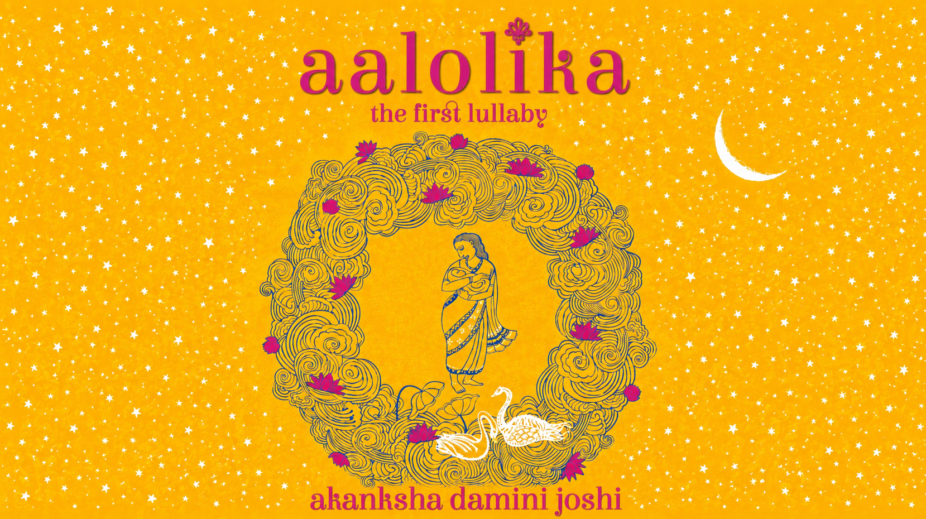
One of the recurring stories about Akanksha Damini Joshi is that people fall asleep when she tells a story.
Not because the story is dull. Quite the opposite.
Somewhere between a goddess appearing in a village lane and a camel crossing a salt desert, between a memory of her mother and a meditation sutra, something subtle begins to happen. The listener relaxes. Defences soften. The urgency of the day quietly recedes. A mind that moments earlier was racing through deadlines, notifications, and anxieties slowly surrenders to the rhythm of the narrative. Before long, many find themselves drifting into a peaceful sleep, carried not by fatigue but by the cadence of her voice.
People fall asleep.
For most storytellers, this would be failure.
For Akanksha, it may be the highest compliment.
While travelling through Tripura, this curious phenomenon finally began to make sense. Members of the indigenous communities, speaking in their melodious Kokborok language, smiled knowingly and offered an explanation.
“In a previous life,” they said, “you must have left a story unfinished. The spirit of that incomplete tale has followed you into this lifetime. Every time you begin telling a story, it gently draws your listeners into a peaceful sleep. It is your karma.”
Whether they meant it literally or playfully hardly mattered. Like all good stories, the explanation carried a truth deeper than its words. It suggested that stories are never merely told; they journey across lives.
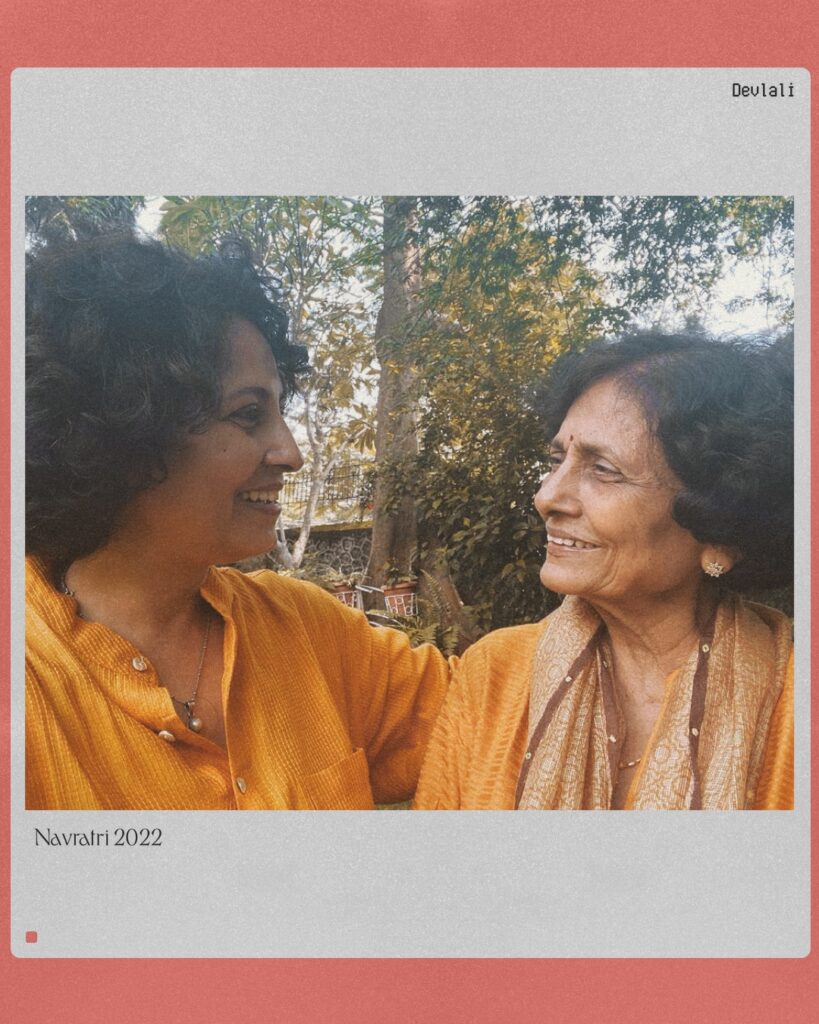
With Ma Gauri
Her first book, Aalolika, derives its name from the gentle humming sound with which a mother lulls her child to sleep. The Sanskrit word evokes that delicate threshold between waking and dreaming, where the mind ceases to resist and becomes receptive to deeper impressions. Long before she wrote a book by that name, Akanksha appears to have been practising its essential art—the ability to gently lead people into another state of awareness.
To understand where this gift comes from, one has to return to the child.
The photographs from different stages of her life reveal someone whose imagination was shaped through immersion. Her childhood unfolded amidst journeys, temples, rivers, village festivals, sacred landscapes, and above all, the stories of the women who raised her.
Her Amma, Kaushalya – sharing the name of Shri Rama’s mother – filled her childhood with stories. Those stories, Akanksha writes, flowed “from sacred peaks, curved around the mountains of my emotions, and landed ever so gently in the valley of wisdom.” They met the child exactly where she was. “If I was cranky, she’d tell me a tale to lighten my mood. If I was sad, she’d offer me a tale that helped me understand my sadness.”
Kaushalya Amma passed on the storytelling traditions of both Kashmir and Kumaon. Born and brought up in बारामूला (Baramulla) Kashmir, she was the daughter of the chief conservator of forest of Raja Hari Singh, in the early 20th century. There are stories, within stories.
If Amma taught her the power of stories, Nani – Govindi, the feminine form of Govinda – taught her how to inhabit the space that flowed between them.
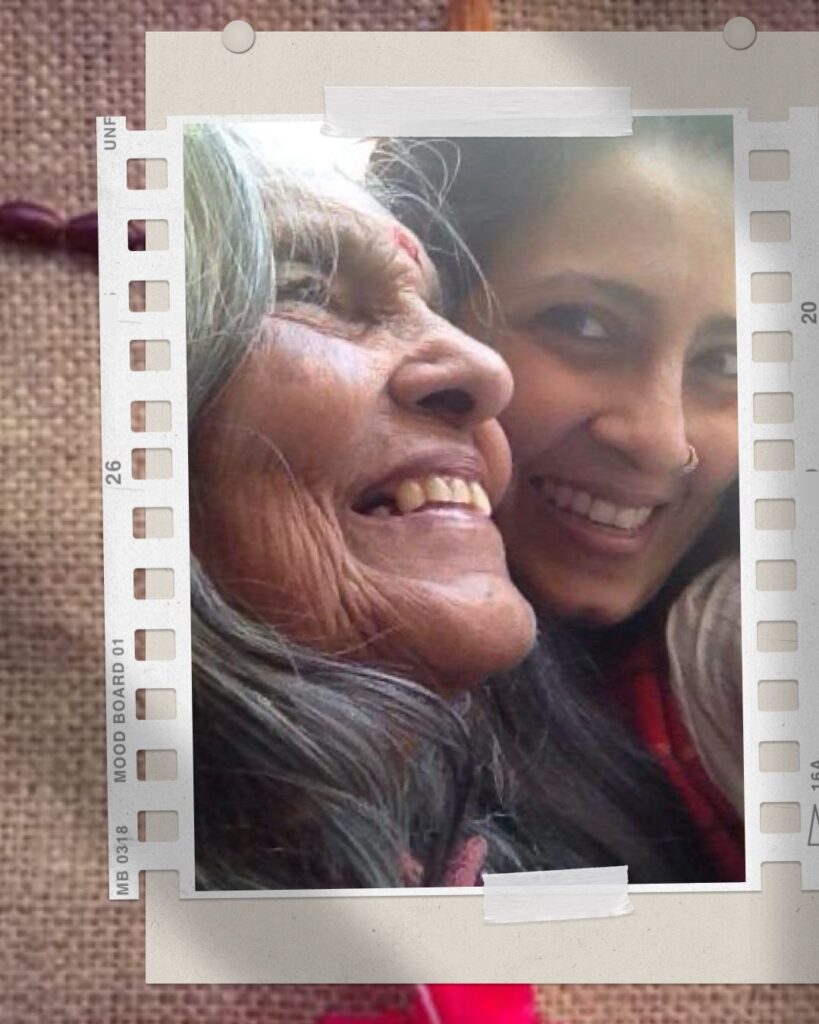
With Nani Govindi
Reflecting on those years, Akanksha writes that Nani showed her “how to live that aspect which flows between the stories. In India we call that rasa… dancing past the dry desert of thought, the rocks of doubt, into the ocean of the heart. Going deeper, deeper still.”
Akanksha’s Amma was Kaushalya. Her Nani was Govindi. Her own mother is Gauri, the beloved of Shiva. One grandmother nurtured her imagination through stories; the other awakened her to the silent current beneath them. Her mother became the pied piper who drew children into wonder while balancing a home, her career, and the demanding life of an Army officer’s wife.
Reflecting on this inheritance, she writes, “These mothers made the Gods, the God-Stories and the God-Wisdom real for me. As a child, I experienced them not just telling me the katha but living the katha – the stories of the Gods – through their own lives and loves, their challenges and their response to those challenges.”
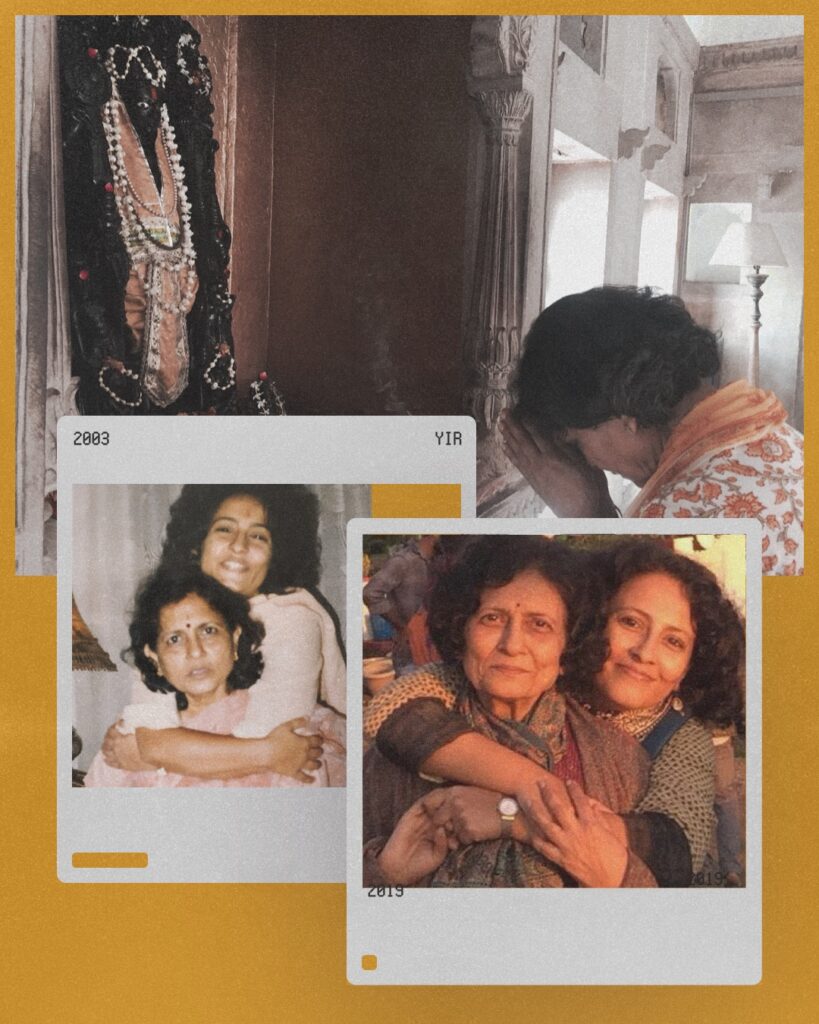
With Ma Gauri
The gods did not first arrive through temples or scriptures. They arrived through the women in her family. Stories were not transmitted as belief; it was embodied in everyday gestures of care, resilience, devotion, humour, and grace. The epics were not distant events from another age. They quietly unfolded in kitchens, journeys, festivals, and ordinary conversations.
That distinction matters. Many people learn itihasa. Akanksha grew up inside it.
Her father Brigadier SKH Joshi completed the picture in a different way. As an officer in the Indian Army, he embodied discipline, duty, and courage, yet these were never separated from devotion. Growing up in Gorkha regiments, Akanksha saw that faith was woven into the rhythm of military life. Family prayers in battalion temples, journeys to sacred- places during postings, and the Gorkha war cry – “Jai Maa Kali, Aayo Gorkhali”- formed the backdrop to everyday life. Looking back at photographs from Nathu La Pass on the China border, where her father served as Deputy GOC in Sikkim, and later at the family praying together as he handed over command of the 5/9 Gorkha Rifles, she remembers the divine was never a separate compartment of life. It was simply part of life itself.
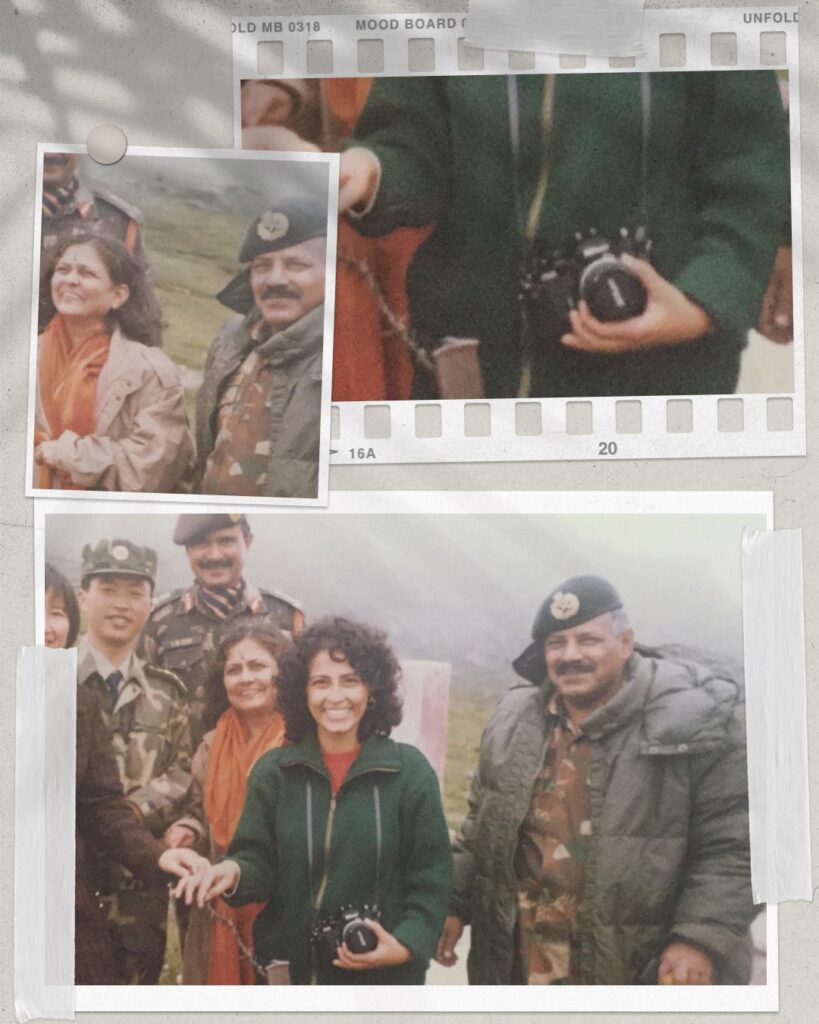
With her father Brigadier SKH Joshi
For her, stories were never narratives with neat beginnings and endings. They were living ecosystems. A tale about Shiva could become a conversation about food. A meal could unfold into an exploration of rasa. A childhood memory could illuminate a meditation practice. Humour, philosophy, devotion, travel, memory, and everyday life constantly flowed into one another, refusing clear boundaries.
That way of seeing never left her.
By every account, her home feels less like a house than an ongoing conversation. Books spill into photographs. Paintings sit beside travel souvenirs. Objects gathered across years of journeys coexist with unfinished creative experiments. Nothing seems arranged according to a designer’s eye or a curator’s plan. Instead, the space reflects the inner landscape of someone who has spent a lifetime collecting stories and allowing them to converse with one another. It was the same eye that would later find expression through the camera.
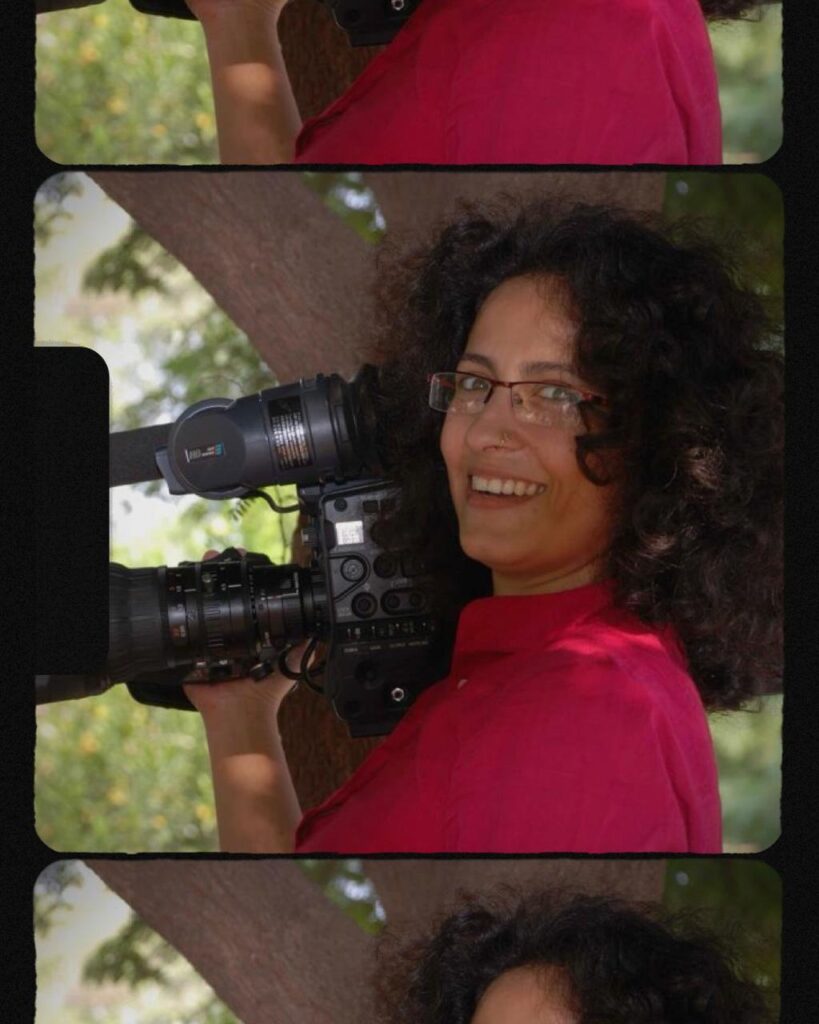
Behind the Camera
It was perhaps inevitable that she would become a filmmaker. Filmmaking became an extension of that way of seeing. Over the next two decades, she travelled across India documenting social conflict, natural disasters, environmental crises, and communities living on the margins.
Yet, amidst these crises, one pattern repeatedly revealed itself. Whether she was filming tribal communities living in fragile ecological landscapes, families rebuilding after disasters, or people navigating conflict, she found that what sustained them was not merely material resilience. It was their relationship with the sacred, expressed through rituals, songs, festivals, stories, temples, shrines, and countless local traditions. Across India’s astonishing diversity, the sacred remained the invisible thread that carried people through suffering and beyond it.
This insight shaped many of her films. Earth Witness (2011), an internationally acclaimed documentary on climate change, explored environmental change through the lives of indigenous communities across India’s ecological zones and won a nomination for the Wildscreen Panda Awards. Chilika Bank$ (2008) which highlights ecological transformations in Chilika Lake, received the Karamveer Puraskar for social justice advocacy. Hindu Nectar: Spiritual Wanderings in India (2014) captured India through the eyes of those not blessed to be born here.
Her work also ranged from documenting technological innovation in MICROSPIN and TERI’s Oil Zapper project to making a film on the Right to Information movement with Arvind Kejriwal during his years at Parivartan, collaborating with Oxfam on the United Nations Millennium Development Goals, and serving briefly as Executive Producer of the news channel Janmat.
From the outside, it appeared to be a successful career in documentary filmmaking.
Yet the deeper she travelled through other people’s stories, the more insistently another journey called to her – an inward one. The camera had taught her to observe the outer landscape with extraordinary attention. Meditation invited her to turn that same gaze upon the landscape within.
Still, she did not abandon storytelling.
She simply changed the direction of the lens.
The camera had brought her to the threshold. Meditation invited her to step through it.
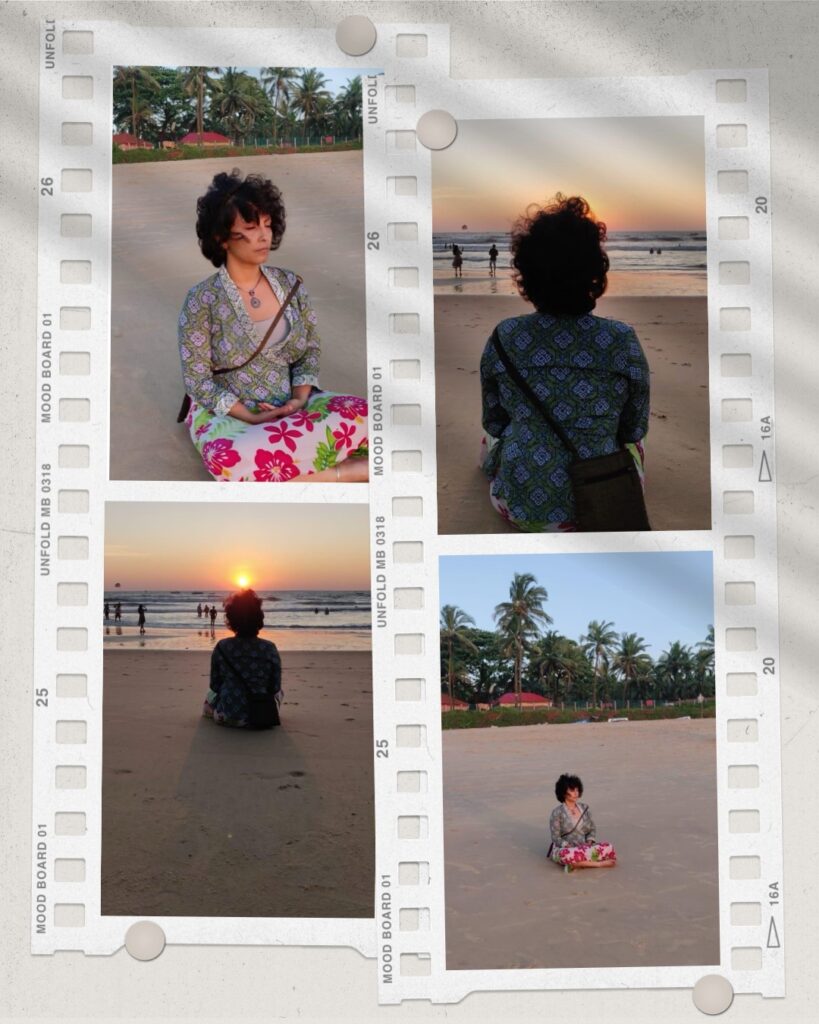
Meditation: First solo, then a community
What began as a life immersed in stories gradually deepened into one shaped by inquiry. The worlds of the Nath tradition, the Shaivagamas, Tantra, and contemplative practice became central to her journey. Yet the deeper her contemplative inquiry became, the more profoundly she recognised the wisdom concealed within stories.
This inward journey did not lead Akanksha away from the world. Instead, it transformed the way she engaged with it.
She became increasingly aware that some of the country’s deepest knowledge could never be fully captured in books or archives. It resided in the body – in the hands of an artisan, the voice of a storyteller, the rhythm of a ritual, the movements of a dancer, the memory of a wandering monk, and the countless practices passed from one generation to the next through observation rather than instruction.
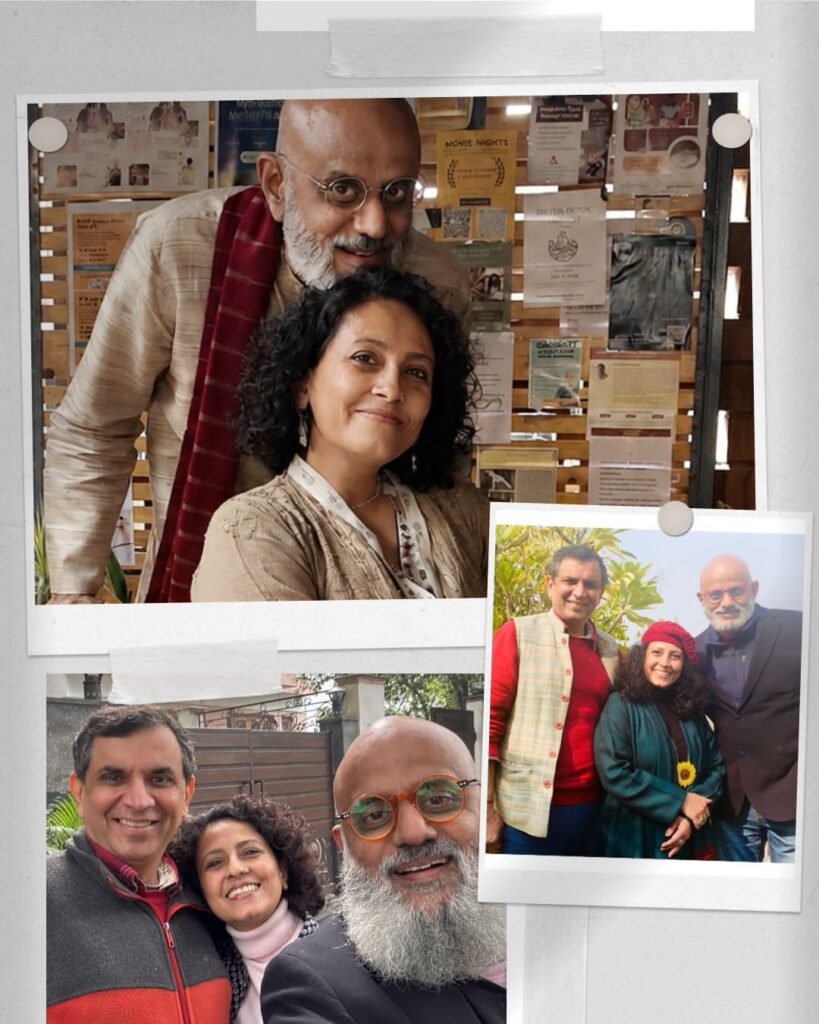
With Sunny Narang and Hari Vadlamani
This realisation led to the founding of the Centre for Embodied Knowledge (CEK), which she co-founded with Hari Vadlamani and Sunny Narang. The Centre emerged from a simple but profound conviction: that India’s civilisational inheritance is not contained only in its texts but also in its living practices. Craft traditions, oral narratives, ritual performances, handlooms, music, foodways, and sacred geographies all carry forms of knowledge that can only be understood by participating in them.
Rather than treating these traditions as museum artefacts, CEK seeks to document them as living processes. Its work brings together film, photography, sound, research, and field documentation to preserve not merely what practitioners make, but how they think, move, remember, and transmit their knowledge.
Projects such as the revival and documentation of the Marwar Block Print tradition, the Bhikshavritti Festival celebrating India’s wandering ascetic traditions, and extensive documentation of village knowledge systems reflect this approach.
In many ways, the Centre represents the convergence of Akanksha’s life’s work. The filmmaker who spent two decades documenting India’s diverse communities, the seeker drawn towards meditation, and the storyteller shaped by generations of women in her family all meet in a single question: how does a civilisation remember itself?
For Akanksha, the answer has always been the same. Through the stories people tell. Through the practices they embody. And through the wisdom they quietly live.
That insight eventually became Aalolika.
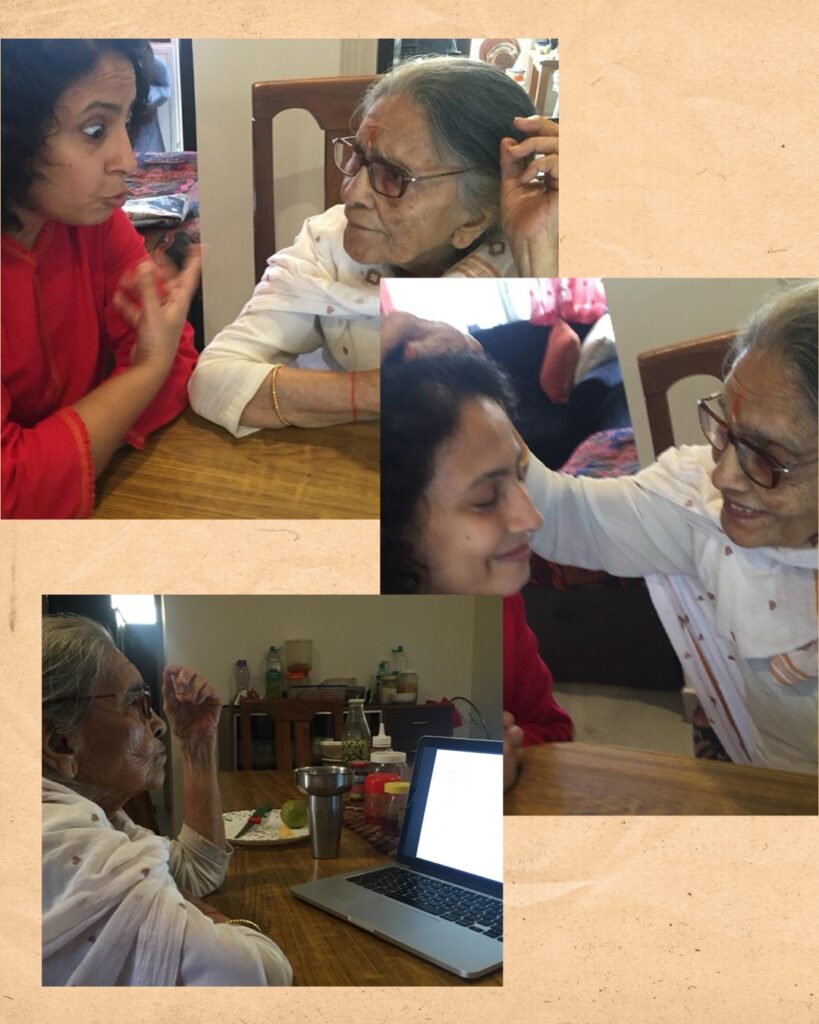
Aalolika being told to Nani in 2017
Aalolika unfolds through three concentric mandalas. The outer mandala gathers stories of gods and goddesses passed down through generations of Indian mothers. The middle mandala offers meditation sutras distilled from contemplative traditions. The innermost mandala presents photographs from everyday life, quietly revealing the sacred hidden within ordinary moments.
On paper, it appears to be an elegant literary structure. In reality, it is the map of her own life. The stories came first. The sutras came later. The silence had always been present beneath both.
What makes Aalolika distinctive is its refusal to separate these dimensions. The stories are not merely stepping stones to philosophy. The philosophy is not simply preparation for meditation. The photographs are not illustrations. Each mandala completes the others, suggesting that the sacred is woven into the texture of everyday life.
A cup of tea.
A village kitchen.
A game of Ludo.
A camel crossing the desert.
A grandmother telling a story.
A child slowly drifting to sleep.
Perhaps this is why people fall asleep when Akanksha tells stories. She is not trying to entertain or persuade. She is recreating one of humanity’s oldest forms of care. The child who once received those stories never really disappeared. She simply grew up to become the one who tells them.
(This is the first of a three part series on Sadhana and Creativity with Akanksha Damini Joshi, Co-Founder CEK. Aalolika: The First Lullaby, her first book is available here.)
